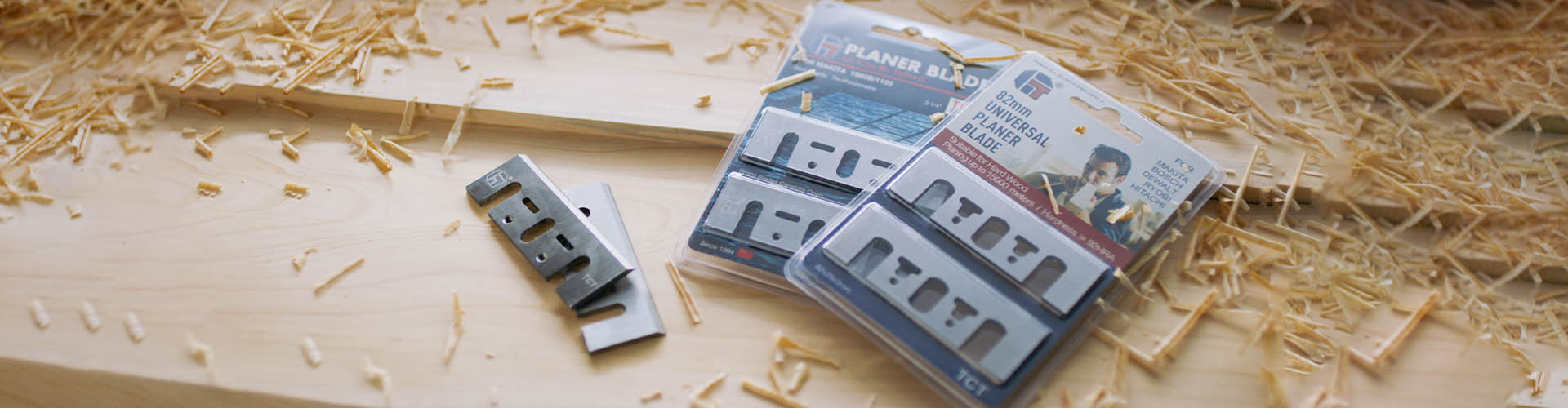
Can the Universal Adaptor break down brand barriers with its multi-functional capabilities, making woodworking planing more efficient and flexible?
Publish Time: 2026-02-03
In woodworking workshops, furniture repair sites, and even on the workbenches of DIY enthusiasts, electric planers are key tools for shaping the smoothness and thickness accuracy of wood surfaces. However, different brands of equipment use different specifications of planer blades, often limiting users to a "one machine, one blade" approach—replacing consumables requires matching the original manufacturer's model, resulting in high prices, complex inventory management, and even the unavailability of parts due to discontinuation. The Universal Adaptor—a cross-brand connector designed specifically for 82mm sharpenable planer blades—is quietly breaking this constraint with its excellent compatibility and plug-and-play convenience, allowing planing operations to return to their essence of efficiency, economy, and freedom.Its core value is primarily reflected in its broad compatibility with mainstream brand equipment. Whether it's Makita, Bosch, DeWalt, Milwaukee, or internationally renowned brands such as Ryobi, Hitachi, and Hikari, this adapter can precisely connect to their planer cutter shaft systems without requiring machine modifications or special tools. Users simply install the standard 82mm planer blade onto the adapter and then insert the entire assembly into the machine for secure clamping and concentric operation. This "one-device-for-all" design completely eliminates brand lock-in, giving users control over consumable selection.In terms of user experience, the no-sharpening and plug-and-play features significantly improve work efficiency. Traditional grindable blades can be resharpened multiple times, but each time they become dull, they need to be disassembled and sent for repair or resharpened manually, which is time-consuming, labor-intensive, and requires high technical skills. However, with the standard blades used with the universal adapter, once dulled, a new blade can be directly replaced, requiring no professional skills, and the machine can be restored to its original sharpness within minutes. Especially for small and medium-sized workshops or users who frequently switch tasks, this "quick change" mode greatly reduces downtime and ensures production continuity.A deeper significance lies in lowering the barrier to entry and reducing long-term costs. The universal blade market has ample supply and transparent pricing, far lower than some original equipment manufacturer (OEM) blades; the adapter itself is robust and durable, and a one-time investment can serve multiple machines for a long time. Ordinary users are no longer limited by brand differences, and even beginners can easily complete the replacement, truly achieving "everyone can operate it, and it's replaceable everywhere." This decentralized consumable ecosystem is driving woodworking tools towards a more open and user-friendly evolution.Furthermore, precision manufacturing ensures operational safety and processing quality. The high-quality adapter is precision-machined from high-hardness alloy steel, with strictly controlled tolerances for the inner hole and positioning surface, ensuring minimal runout after blade installation and avoiding vibration, noise, or uneven cutting caused by eccentricity. Even at high-speed rotation, it maintains stable clamping force, preventing blade loosening and ensuring operational safety. Surface rust-proofing also extends its service life in humid workshop environments.Ultimately, the value of a universal adaptor lies not in its complexity, but in how it allows tools to return to their essential purpose of serving people. When sawdust flies and the planer runs smoothly, users no longer worry about not finding matching blades—at that moment, technology fades into the background, and efficiency and freedom take center stage. Because in a truly human-centered tool philosophy, the best innovation is not to create more exclusive accessories, but to remove barriers so that every replacement is as simple as breathing—silent as iron, yet unimpeded.