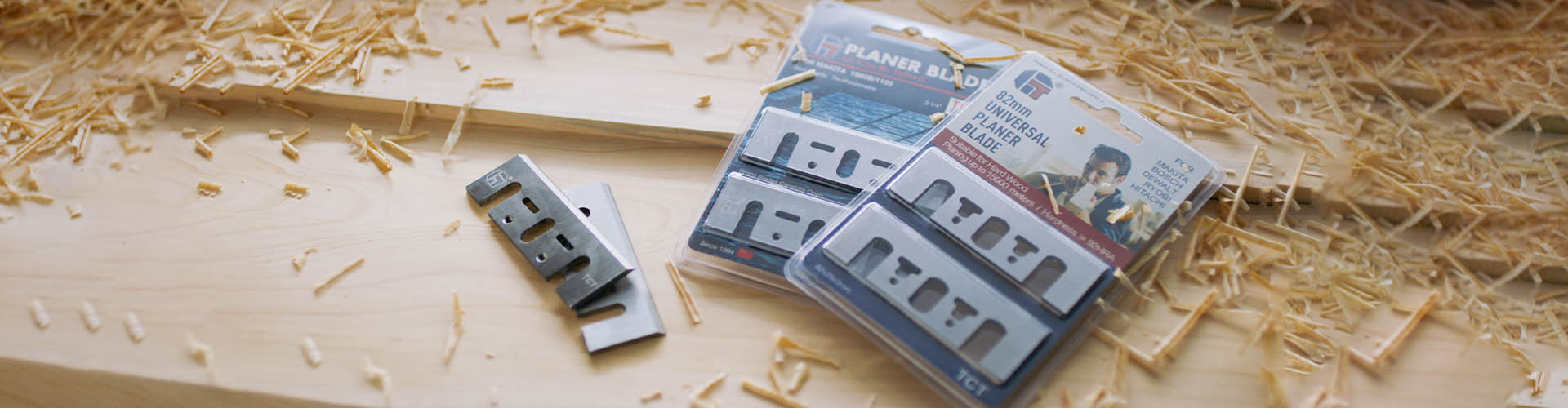
How do universal planer blades maintain their sharpness and prevent chipping when cutting high-density materials like mahogany and compressed bamboo at high speeds?
Publish Time: 2026-01-19
In woodworking, high-density or composite materials such as mahogany, compressed bamboo, and glued laminated wood are known for their hardness and density, posing a challenge to both craftsmanship and the limits of tool performance. Ordinary steel blades often dull quickly, chip, or even break upon impact when cutting these materials, affecting processing efficiency and potentially causing surface tearing or abnormal equipment vibration. The key to the consistently clean and sharp cutting performance of high-performance universal electric planer blades under such demanding conditions lies in their use of tungsten carbide as the core material, combined with precise structural design and reliable manufacturing processes, achieving a cutting wisdom that balances hardness and flexibility.Tungsten carbide is a cermet material synthesized from tungsten and carbon at high temperatures. Its hardness approaches that of diamond, and its wear resistance far exceeds that of high-speed steel. When used as the cutting edge of a planer blade, it cuts smoothly even through the densely interwoven fibers of mahogany, the high proportion of adhesives in compressed bamboo, or the heterogeneous particles in recycled wood, with minimal wear. However, hardness is not the only consideration—if the material is too brittle, it is prone to chipping under high-speed impact. Therefore, high-quality planer blades use a high-toughness tungsten carbide formula. By controlling the proportion of cobalt and other metallic binder phases, it maintains ultra-high hardness while giving the blade a certain degree of impact resistance. This allows it to "overcome hardness with toughness" when encountering wood knots, sand, or glue particles, preventing micro-cracks from spreading and causing the cutting edge to break.But this is not enough. A truly reliable planer blade also requires a firm bond between the tungsten carbide and the blade body substrate. Typically, the tungsten carbide tip is precisely fixed to a high-strength alloy steel substrate through high-temperature brazing or laser welding. This connection must be uniform, free of pores and incomplete welds; otherwise, under the centrifugal force and cutting reaction force of thousands of revolutions per minute, the tip may loosen or even fly off, posing a safety hazard. Excellent manufacturing processes ensure a reasonable stress distribution at the weld interface, keeping the tungsten carbide cutting edge consistently stable even during high-speed rotation.Furthermore, the cutting edge geometry and grinding precision also determine performance in actual use. Even with the same material, an improperly designed rake angle, clearance angle, or cutting edge can lead to excessive cutting resistance or poor chip removal, exacerbating heat generation and wear. High-performance universal planer blades often employ optimized blade shapes proven in woodworking practice, combined with mirror-finish grinding, resulting in a cutting edge that is both sharp and strong. During cutting, wood chips are smoothly discharged, and frictional heat is effectively controlled, thus preventing tungsten carbide embrittlement or matrix deformation due to localized overheating.It is worth mentioning that dynamic balancing design is also an invisible safeguard. If the blade has mass eccentricity after installation, high-speed rotation will generate severe vibrations, accelerating blade fatigue and affecting planing smoothness. Precision stamping and leveling processes ensure uniform overall blade mass distribution, perfectly matching mainstream brand planers and achieving stable operation.Ultimately, the universal planer blade's composure in the face of high-density wood is not accidental, but rather the culmination of materials science, mechanical engineering, and woodworking experience. It doesn't rely on brute force, but rather uses its ultra-hard blade to overcome obstacles, its resilient body to withstand pressure, and its exquisite shape to guide the flow. When a blade can leave a silky smooth cut on the surface of mahogany, it's not just a victory for the tool, but a silent practice of the woodworking ideals of "efficiency, labor-saving, and durability"—because true sharpness is never a fleeting moment of prowess, but rather a lasting reliability that withstands the dual test of time and the hardwood's tempering.