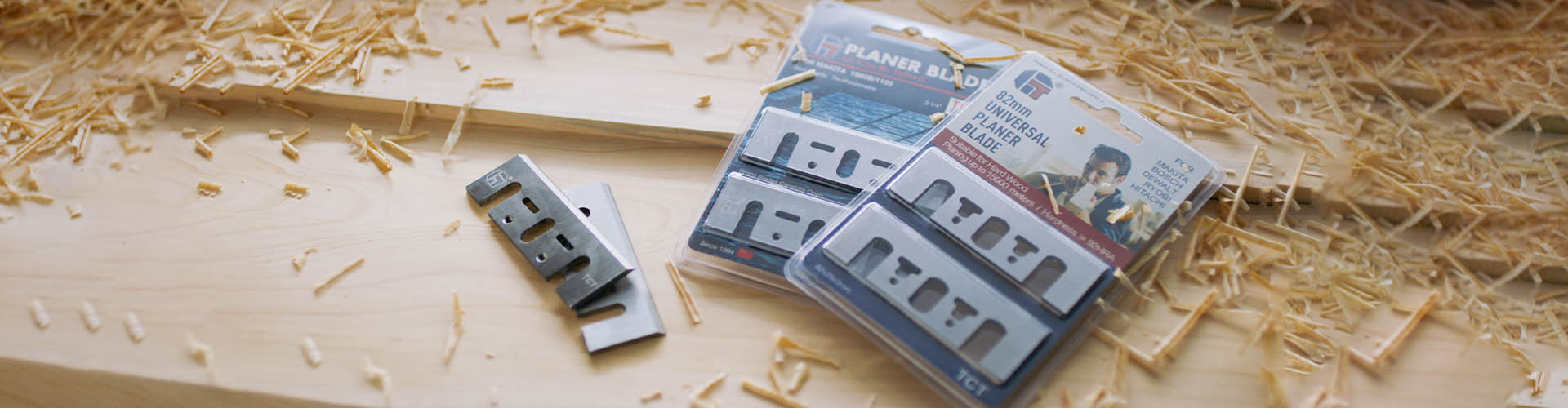
How do woodworking machine planer knives affect cutting efficiency and wood surface finish?
Publish Time: 2026-03-19
In woodworking, whether by hand or machine, the planer blade, as the cutting tool that directly contacts the wood, directly determines processing efficiency and finished product quality. Woodworking machine planer knives not only improve cutting smoothness and reduce energy consumption, but also achieve a high-gloss finish with an instant mirror finish, significantly reducing the need for subsequent sanding. Their impact on cutting efficiency and surface finish is mainly reflected in four aspects: blade geometry design, material hardness, sharpening precision, and installation condition.1. Blade Angle: Balancing Sharpness and StrengthThe rake angle of the planer blade is a key parameter affecting cutting force. A smaller rake angle makes the blade sharper, with less cutting resistance and a lighter cutting motion, suitable for softwood or fine finishing; while a larger rake angle requires more thrust, but the blade strength is higher, suitable for hardwood or knotty wood, preventing chipping. The back angle affects the friction between the cutting edge and the machined surface—too small an angle can easily scratch the surface, while too large an angle weakens the cutting edge strength. A properly matched back angle ensures cutting efficiency while achieving a smooth, burr-free surface.2. Materials and Heat Treatment: Determining Wear Resistance and Edge RetentionWoodworking machine planer knives are mostly made of high-speed steel or cemented carbide. High-speed steel, after quenching and tempering, combines toughness and wear resistance, making it suitable for general machining. Its excellent wear resistance is particularly suitable for high-density hardwoods, plywood, or resin-containing woods, maintaining sharpness for extended periods and significantly improving continuous working efficiency. Furthermore, some high-end planers undergo cryogenic treatment to refine the grain structure, further extending the cutting edge life.3. Sharpening Precision: Microscopic Smoothness Determines Surface QualityEven with excellent materials, if the cutting edge has tiny serrations, curling, or unevenness, it will leave scratches or tear fibers on the wood surface. High-precision sharpening achieves a mirror-like smooth cutting edge, enabling "shearing" rather than "tearing" cuts. Especially when processing hardwoods with interlocking grains, such as maple and cherry, the sharp, smooth cutting edge effectively cuts through the fibers, preventing fuzzing and chipping, and directly producing a surface close to sanding.4. Installation and Adjustment: Ensuring Uniform Cutting DepthThe flatness and consistent protrusion of the planer blade within the planer or hand planer body are equally crucial. Uneven height at both ends of the blade will cause ripples or unevenness on the wood surface; insufficient clamping will generate vibrations during high-speed rotation, leading to chatter marks. Precisely adjusted planers can cut at a constant depth, improving efficiency and ensuring surface consistency.While small, woodworking machine planer knives are a bridge connecting craftsmanship and aesthetics. From material selection to geometric design, from sharpening techniques to installation precision, every step profoundly affects cutting efficiency and surface finish. A well-maintained, high-quality planer not only makes woodworking easier and more efficient, but also brings out the natural beauty of the wood, truly achieving the ideal of "one-cut shaping, no sanding required".