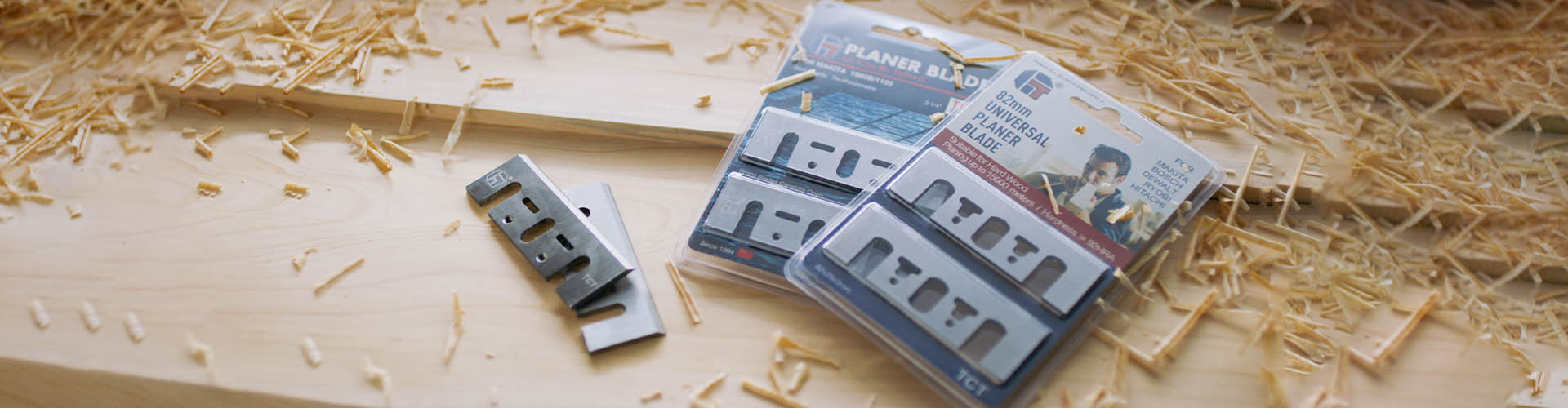
Can the Universal Planer Blade unlock the full potential of efficient woodworking?
Publish Time: 2026-03-02
In the roar of the woodworking shop, the electric planer is the core tool for shaping wood, but what truly determines processing efficiency and surface quality is often that seemingly small yet incredibly sharp universal planer blade. Crafted from high-hardness tungsten carbide, it not only effortlessly cuts high-density materials such as mahogany, hardwood, and compressed bamboo, but also boasts broad equipment compatibility, making it a reliable alternative to many international brands' 82mm blades. Quiet and unassuming, it silently enhances the precision and rhythm of woodworking with its exceptionally long lifespan and stable cutting performance.Its core advantage stems primarily from the extreme wear resistance and impact resistance provided by tungsten carbide. Compared to ordinary high-speed steel blades, tungsten carbide has higher hardness and thermal stability, making it less prone to dulling or chipping even during prolonged high-speed cutting. Even when faced with resin-rich pine, mixed-grained wood, or high-density glued laminated timber and recycled compressed lumber, the blade remains sharp, producing a smooth and delicate cut, significantly reducing subsequent sanding. This "one-step molding, less repair and grinding" characteristic directly translates into time and cost savings, allowing carpenters to focus on the creative process rather than the tedious task of frequent blade changes.In terms of compatibility, versatility is not a compromise, but rather the result of precise adaptation. Through in-depth research into the interface dimensions, installation methods, and dynamic balance requirements of mainstream brands such as Makita, Bosch, Ryobi, and Hitachi, the planer blade achieves a high degree of matching in key parameters such as thickness, bore diameter, and positioning grooves, ensuring smooth, vibration-free, and noise-free operation after installation. Users can enjoy the upgraded experience brought by high-performance blades without replacing the entire machine or special parts. This "plug and play" convenience is especially suitable for small and medium-sized workshops or mobile construction teams that use multiple brands of equipment.A deeper value lies in supporting sustainable operating models. An extended lifespan means fewer blades consumed and discarded, reducing consumable costs and resource waste; stable cutting force reduces motor load and extends the overall machine lifespan; a smooth planing surface also reduces dust generation, improving workshop air quality. In today's era of advocating green manufacturing and lean production, the ripple effects of a high-quality blade far exceed its intrinsic value.Furthermore, meticulous craftsmanship reflects a professional attitude. The blade edges are precision-ground for high consistency; the surface coating further enhances anti-adhesion properties, preventing sawdust buildup from affecting cutting; the packaging features a moisture-proof and impact-resistant design, ensuring safe transportation and storage. These seemingly small details reflect respect for the dignity of the woodworking profession—reliable tools allow craftsmanship to be purely expressed.Ultimately, the significance of a universal planer blade lies not in how many types of wood it can cut, but in how it makes every plane a continuation of fluid creation. When sawdust falls like silk, when curves are formed in one smooth motion—behind this small blade, with its silent sharpness, it protects the warmth and efficiency of woodworking. In the world of woodworking, where manual labor and machinery intertwine, true efficiency lies not in blindly increasing speed, but in letting the tools remain hidden behind the craftsmanship, allowing only the finished product to speak for itself—silent as a blade, yet possessing its own sharpness.